


A driveway that dips near the garage or a sidewalk with a raised edge can seem to change overnight. Usually, though, sinking concrete develops gradually as the ground below a slab changes. Concrete needs consistent support, and when that support shifts or disappears, part of the surface may settle. Understanding why it happens can help Colorado homeowners recognize a problem before it becomes a bigger inconvenience.
Soil Settlement Can Leave a Slab Unsupported
Concrete is heavy, and the soil beneath it must be properly compacted to carry that weight. If fill soil continues to compress after construction, or if the ground settles unevenly, a slab may drop in one area while the rest stays put.
Colorado also has soils that respond strongly to moisture. The Colorado Geological Survey explains that expansive clay can swell when wet and shrink as it dries. This movement may contribute to cracks and sinking concrete around homes. Not every sinking slab has the same cause, so the visible dip alone cannot tell you exactly what is happening underground.
Water Can Wash Away Support
Rainwater, runoff from downspouts, and irrigation can affect the ground around a driveway or patio. When flowing water carries soil away, it can leave empty spaces beneath the surface. These voids can lead to sinking concrete and cracks.
Look at where water goes during a storm. Does it collect beside the sidewalk, run toward the garage, or drain toward a low patio? Pooling water does not prove that erosion caused sinking concrete, but it is a useful detail to share during a repair assessment. Managing runoff may also be part of preventing the same conditions from continuing.
Freeze-Thaw Cycles Add Movement
Colorado’s temperature swings can be hard on outdoor surfaces. Moisture in the ground may freeze, expand, and then thaw. Repeated changes can contribute to soil movement, particularly where water collects beneath or alongside a slab.
Freeze-thaw cycles are not the only explanation for sinking concrete. They often work alongside soil and drainage conditions, which is why looking only at a crack or low spot can miss part of the story.
Signs It May Be Settling
You do not need special equipment to notice that something has changed. Watch for:
- One driveway section sitting lower than the next
- A sidewalk edge that catches your foot
- A patio sloping toward the house instead of away
- Gaps where concrete meets steps or a garage
- Cracks accompanied by a change in slab height
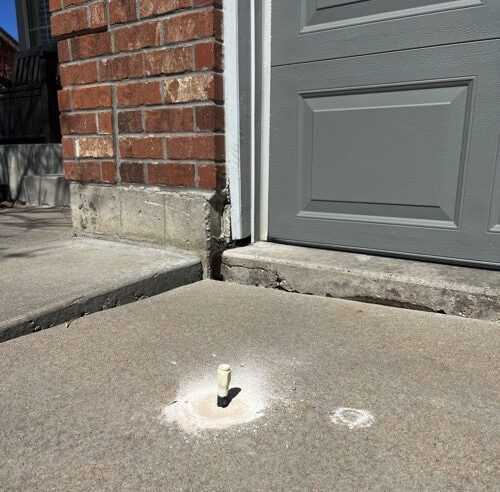
These signs deserve attention, especially when they create a trip hazard or direct water toward the home. A crack by itself does not necessarily mean the slab is sinking; what matters is the overall condition and movement.
Can Sinking Concrete Be Lifted Instead of Replaced?
In some cases, yes. If the existing slab is suitable for repair, lifting may restore a more even surface without tearing it out. At Align Concrete Lifting, our team drills small holes in the affected concrete and injects expanding polyurethane foam underneath. The foam fills voids and raises the slab while helping stabilize the area below.
We use this method on suitable driveways, sidewalks, patios, garage floors, steps, and other concrete surfaces. Treated areas can often be walked or driven on within minutes, although the right solution depends on the slab and site conditions.
Get to the Bottom of Uneven Surfaces
Sinking concrete is easy to see, but its cause may be hidden. Whether the issue involves soil settlement, water, or seasonal movement, identifying what is happening beneath the surface is the starting point for a sensible repair.
If your driveway, patio, or sidewalk has started to sink, contact us for a free inspection. We can evaluate the affected area and discuss whether polyurethane concrete lifting is an appropriate way to restore it.